
Understanding Johnson County Released Inmates
Johnson County does not operate an adult jail. The sheriff can arrest, transport, and retain Johnson-created records while Massac County Jail or Saline County Detention Facility holds the person. A released person normally disappears from the host's current-custody view. That disappearance is not proof of a return to the community. The person may have transferred to IDOC, another county, ICE, USMS, or a medical setting.
A useful release record answers who, from where, when, and to what status. The releasing agency and destination matter as much as the date. Johnson Sheriff records identify the host. The host jail records the physical exit. The Johnson court file explains the order or disposition. If state prison followed, IDOC becomes the custodian. These records should be joined, not substituted for one another.
Johnson County Release Types Explained
Release labels describe distinct events. Illinois's current pretrial system uses court-ordered release, detention, and conditions rather than casual claims that someone “posted bond.” Historical records may still use bond or recognizance terms. Always read the date and destination with the label.
| Type | Meaning | Next record |
|---|---|---|
| Pretrial release | Jail custody ends under court conditions. | Host movement and Johnson order |
| Time served | A local term ends through sentence or credit. | Judgment, credit entry, host release |
| Dismissal | The charge ends, though another hold may remain. | Court disposition and host record |
| IDOC transfer | County-jail custody ends and state custody begins. | IDOC profile |
| Parole or MSR | Prison confinement ends while supervision continues. | IDOC and PRB records |
| Final discharge | The applicable sentence or supervision ends. | Agency discharge record |
A detainer or other-agency handoff is a transfer, not community release. Death, escape, and medical transport are status changes, not ordinary releases.
Johnson County Release Record Fields
Field names differ by custodian, so request observed records rather than inventing a standard Johnson form. The core inventory below identifies the facts needed to interpret a release.
| Field | What it shows |
|---|---|
| Name, age or birth date, aliases | Distinguishes similar identities. |
| Booking or IDOC number | Links the event to one custody record. |
| Arresting and releasing agencies | Connects Johnson's arrest to the host. |
| Booking and release timestamps | Shows the custody interval and physical exit. |
| Court or case number | Links the movement to the legal file. |
| Release type and authority | States the recorded basis for the change. |
| Destination or supervision | Separates community exit from transfer or oversight. |
The court order may precede actual processing. Another hold can delay the exit. The host movement plus the court entry is stronger than either alone.
Request Johnson County Release Records
Local release evidence may require two narrow requests. Johnson holds the arrest and transport trail. The host holds the booking and release movement.
- Ask the Johnson County Sheriff for the receiving jail, transport date, and incident or warrant identifiers.
- Send the confirmed host the person's identifiers and approximate booking period.
- Request the booking/release entry, timestamp, authority, type, destination, case number, and photograph if maintained and nonexempt.
- Ask for an electronic copy and keep the scope record-specific.
- Use the Circuit Clerk for certified court orders, not FOIA.
Illinois FOIA generally allows delivery by mail, fax, personal delivery, or another channel the agency offers. Ordinary noncommercial requests generally receive a response within five business days, subject to a written statutory extension. A response may produce records, deny, extend, or seek clarification. The first 50 standard black-and-white pages are generally free, then copies may cost 15 cents per page. Electronic production avoids many copy charges.
Illinois Law on Johnson Release Records
Illinois FOIA, 5 ILCS 140, presumes public-body records open and places the burden for an exemption on the public body. That presumption does not make every booking, photo, juvenile, medical, victim, or investigative field public. A focused request lets an office redact exempt material and release the rest.
No verified Johnson, Massac, or Saline release-record retention period was found. An expired web card does not prove destruction. Illinois's approved expungement and sealing forms and 20 ILCS 2630/5.2 control those processes. Expungement and sealing are distinct. A no-result search can reflect indexing, age, confidentiality, sealing, or expungement, so absence carries no single meaning.
Johnson Release Property and Identification
Massac's official inspection checklist requires positive identification, a date, time, and authority record for discharge or transfer, and the return and inventory of personal property. It also calls for a permanent signed property receipt. A Johnson detainee released from Massac should ask Massac for that receipt or release entry when property is disputed.
The Johnson Sheriff may know the original transport but may not possess the host's final receipt. No verified Johnson release counter, exit door, waiting area, or property hours were found. Call the actual host before travel. Saline procedures must be confirmed directly because the research did not establish the same published checklist there.
Who Owns Johnson Release Records?
Record ownership follows creation. Johnson Sheriff creates the local arrest and transport record. Massac or Saline creates the host booking and physical release movement. The Circuit Clerk keeps the legal case. IDOC creates state-prison admission, sentence, release, and discharge records. VINE receives event data but is not the underlying custodian.
This division matters when an office says it has no responsive record. Johnson may be able to name the receiving jail without knowing the final door-out time. The host may document the exit without holding the complete Johnson order. The clerk may hold the order without maintaining a live jail log. Redirect the request to the office that created the missing fact.
For Massac, cite the official inspection's requirement that each discharge, transfer, or release carry a date, time, and authority. For Saline, use the official sheriff page's FOIA route. For IDOC, identify the person by full name and IDOC number, then request specified releasable release, discharge, or sentence-calculation material electronically.
Johnson Release Record Retention
Online visibility and agency retention are different. A current-inmate card is meant to change when custody changes. Its disappearance does not establish the destruction of the booking, photograph, movement, or court file. No defensible host-specific retention term was verified, so ask the custodian whether the requested record remains maintained.
Older Johnson cases often begin with the Circuit Clerk because the court history is more durable than a current-custody app. Use the docket to identify the arrest period, order, sentence, or host, then send that detail to the jail custodian. Judici is a discovery route, while the clerk supplies complete or certified material.
Restricted access also needs careful wording. Juvenile, sealed, expunged, medical, victim, and investigative information may be withheld under applicable law. Sealing limits ordinary public access. Expungement disposes of qualifying records as the statute directs. Neither process should be inferred merely because a name search returns nothing.
When an agency denies or redacts a request, its response should state the legal basis and available review rights. Narrowing the request to dates, movement type, and nonexempt fields can help the office segregate releasable facts without disclosing protected operational or personal material.
Search Johnson County Released Inmates
Start with custody type and identity. Gather the full name, lawful birth date, arrest date, agency, case number, and booking or IDOC number when known.
- Call Johnson Sheriff and identify the physical host.
- Check Massac's current-inmate app route or Saline's official sheriff channel, then request the host movement.
- Search Judici for the Johnson case and obtain complete orders from the clerk.
- Search Illinois VINE for a matching person and reporting custodian.
- If the result says IDOC transfer, use the state offender search.
- Follow any other county, state, ICE, USMS, or medical destination.
The official Johnson Sheriff listing is the local contact route for host identification.
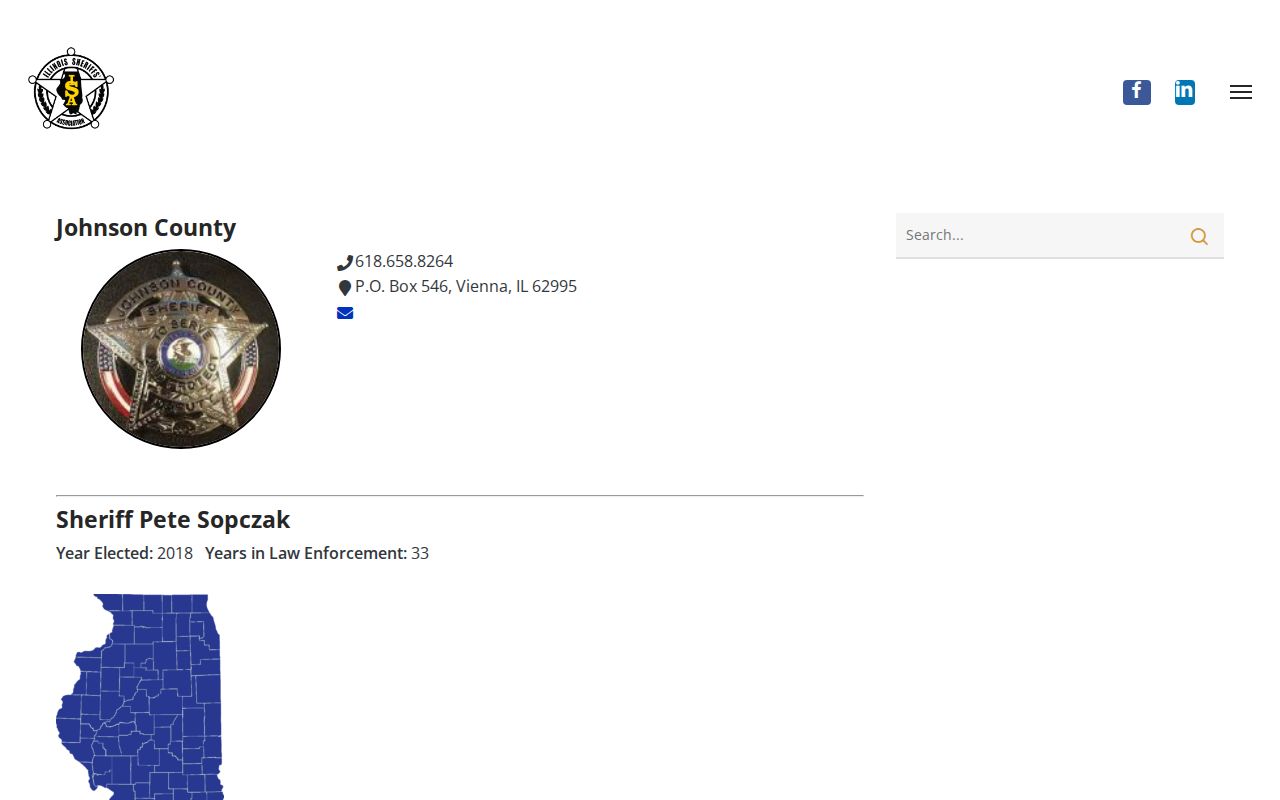
The captured listing supports the first routing step. Its generic jail-address label does not override the documented finding that Johnson lacks an operating adult jail.
IDOC Search for Johnson Releases
The IDOC Individual in Custody Search covers current and former state prisoners. Search by last name, IDOC number, or birth date. The IDOC number is most precise. Compare physical descriptors, sentencing county, and case details before choosing a result.
| Search or result field | Use |
|---|---|
| Last name, IDOC number, birth date | Find candidate records. |
| Offender Status and Location | Read current public classification. |
| Admission Date | Shows entry into IDOC. |
| Last Paroled Date | Records a parole or MSR movement when populated. |
| Projected Parole Date | Future estimate, not actual release. |
| Projected Discharge Date | Estimated end of later legal control. |
The official search capture shows the state route used for Johnson state-prison records.
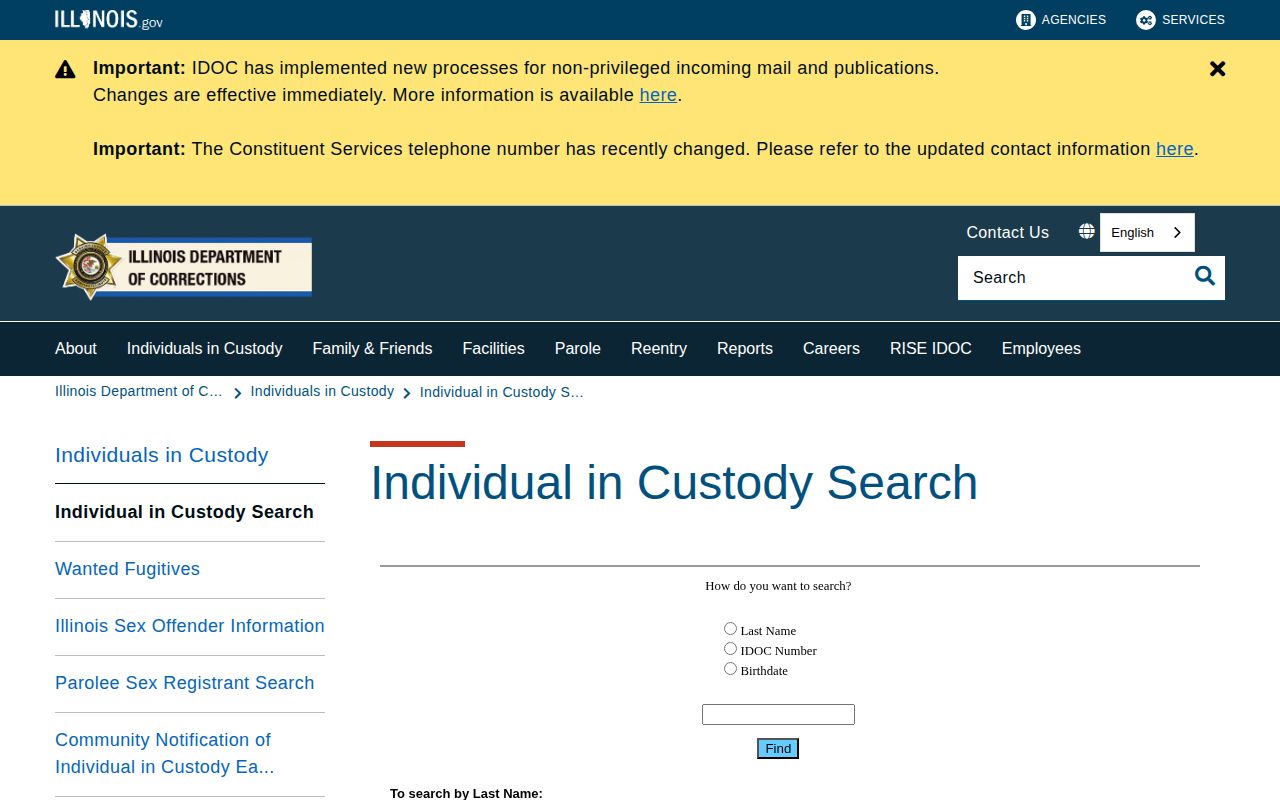
A coherent past release date, non-prison status, and sentence information can establish departure from IDOC. It does not prove release from Massac or Saline.
Johnson County Recent Release Options
No official Johnson 24-hour or 72-hour release feed was verified. Massac's official site routes current-inmate access through its sheriff app but does not promise a release archive. Saline provides an official sheriff and FOIA route, yet no verified recent-release list. Identify the host, request a precise time range, and seek the movement entry.
A rolling window means the stated hours before an endpoint, not a calendar archive. The Johnson same-day release route addresses recent movements. Use direct records for older events.
Johnson Supervision After Release
Parole or mandatory supervised release follows state prison and is supervised by IDOC under Prisoner Review Board conditions. Probation is imposed through the circuit court and can begin without a prison stay. Neither is a list of everyone released from Massac or Saline.
- Parole/MSR
- State supervision after prison confinement ends.
- Probation
- Court supervision imposed in a local criminal case.
- Absconder
- A person alleged to be unavailable to supervision; the earlier release still occurred.
- Discharge
- The end of the applicable supervision or sentence.
Use the IDOC profile and PRB records for state supervision. Use the First Circuit office and Johnson docket for probation. No public statewide probationer name search was verified.
Johnson Release Alerts and Federal Records
Illinois VINE accepts one-person custody or case searches and offers phone, text, email, or app notices where registration is available. Check the reporting agency. A release or transfer alert is corroboration, not a certified host record.
For federal sentenced custody, the BOP locator can show “RELEASED” and a past date for covered records. Federal pretrial movement requires the federal docket, USMS, and actual contract jail. ICE's locator includes current detention and a short post-release period. Release to ICE is a transfer, not community release.
Where Johnson Release Records Appear
The correct source follows the custodian. Use this comparison to avoid treating a current roster as a release archive.
| Status | Source | What it establishes |
|---|---|---|
| Held at host jail | Massac or Saline current channel | Current local custody |
| Left host jail | Host release movement | Exit time, type, destination |
| Current or former state prisoner | IDOC profile | State status and sentence history |
| Federal release | BOP locator | End of BOP custody |
| Legal authorization | Johnson court file | Order, disposition, sentence |
Johnson County Release Facilities
Johnson County Sheriff's Office routes local arrests but is not a verified adult jail. Massac County Jail and Saline County Detention Facility are documented hosts. Their records confirm physical exit.
Vienna Correctional Center and Shawnee Correctional Center are IDOC prisons located in Johnson County. Their releases belong to statewide IDOC records, VINE, PRB, and supervision systems. A prison's local address does not turn its records into Johnson Sheriff records.
Why Johnson Releases Are Ambiguous
Johnson County contains two state prisons while operating no adult county jail. “Released in Johnson County” can mean a Johnson arrestee leaving a host in Metropolis or Harrisburg, an IDOC prisoner leaving Vienna or Shawnee, or a person returning to Johnson under supervision after release elsewhere.
Ask which meaning applies before searching. Host-jail releases use the host movement and Johnson case. Vienna and Shawnee releases use IDOC. Return under supervision uses parole or probation records. Geography alone does not choose the database.
Johnson Court Records After Release
The First Circuit case is often the durable local record after a host card disappears. Judici reports Johnson electronic criminal and civil files current from April 1987, though online coverage can be incomplete. Search by name or case number, then ask the Circuit Clerk for the complete or certified file.
Seek the docket, pretrial order, disposition, judgment, sentence, mittimus, custody credit, probation order, and termination entry as relevant. A sentence imposed is not proof it later ended. A court order also does not prove the exact jail-door time.
The official Johnson courthouse directory lists split business hours, so check the current schedule before visiting. Ask the clerk what copy or certification charge applies because no current Johnson-specific fee schedule was verified. A certified order is useful when exact legal proof matters, while a host release sheet remains the source for the physical exit.
Vienna Release Transition Programs
Vienna Correctional Center lists Field Services, Reentry Summits, Parole School, and TRAC 1. These are specific IDOC transition resources for people leaving that prison. They are not promises for a Johnson arrestee released from Massac or Saline.
IDOC release procedures address property, identification, suitable clothing, reporting instructions, and transport to an approved host or discharge address. Host-jail processes differ and must be confirmed with the actual facility.
A person leaving Vienna or Shawnee may enter mandatory supervised release, parole, another custody, or final discharge depending on the record. Read Offender Status, Location, Last Paroled Date, Projected Discharge Date, and the sentence-discharge flag together. One projected field cannot establish that the person has already left.
Verify Johnson Release Search Results
Use an evidence hierarchy. For a local arrest, the strongest routine pair is the host's dated release movement and the Johnson order or disposition. A VINE alert adds timing support. A roster disappearance, news report, social post, or broad web result is only a lead. Preserve the possibility of transfer until the destination is known.
For IDOC, read the official profile as a whole and contact the agency when completeness matters. For BOP, an explicit “RELEASED” label with a past date is the main public federal route, though supervision or other custody may continue. For ICE, the short post-release display window means an absent result after that period proves nothing.
Similar names create risk across all systems. Compare birth data, booking or agency number, physical descriptors, sentencing county, case number, and reporting custodian. Do not merge records merely because names match. When a source corrects a date or status, retain the updated agency response with the access date.
Finally, state the conclusion narrowly. “Massac custody ended at the recorded time” is more accurate than “the person is free” when the destination is unknown. “IDOC shows a past parole date and non-prison status” is stronger than treating a projected date as an actual release. Precise wording keeps county-jail, state-prison, and federal events distinct.