
Johnson Projected and Actual Release
A projected release date is the agency's current calculation of a future event. An actual release date records a completed movement out of that agency's custody. IDOC uses more exact labels: Projected Parole Date, Last Paroled Date, and Projected Discharge Date. Illinois does not publish one universal field called a tentative release date.
Projected Parole Date is closest to an expected prison exit. Last Paroled Date is historical when populated. Projected Discharge Date concerns the later anticipated end of legal control. Offender Status and Location must be read with all three. A future date does not mean the person has left prison, and a past parole date does not prove supervision has ended.
A pretrial detainee has no sentence-based release date. A court may order release, detention, or conditions, and another detainer may affect the physical exit. The host jail's movement entry shows when staff carried out the order.
Find a Johnson Projected Release
Start with the custodian, not the arrest location. Johnson County contains Vienna and Shawnee state prisons but sends local adult detainees to Massac or Saline. Those are separate calculations and records.
- Identify IDOC, host-jail, or pretrial custody. The Johnson Sheriff can name the host for a local arrest.
- Search the IDOC Individual in Custody Search by number, name, or birthdate. Compare descriptors and case data.
- Read status, location, projected parole, last parole, projected discharge, and sentence-discharge fields together.
- For a host-jail sentence, obtain the Johnson sentencing and custody-credit orders, then ask Massac or Saline for its computation.
- For a pretrial case, follow the docket and ask whether the latest order has been carried out and another hold exists.
The Johnson County release-record search path explains host identification and final movement records.
Illinois Prison Release Date Credits
IDOC starts with the sentence and legally credited custody date. It applies the credit category tied to the offense and offense date, resolves concurrent and consecutive terms, incorporates presentence credit, and accounts for eligible program or earned credit. MSR follows confinement where applicable. IDOC Records controls the actual calculation.
730 ILCS 5/3-6-3 creates several categories. Some listed offenses receive no sentence credit. Others are limited to 85 percent or 75 percent. Qualifying offenses outside those groups may receive day-for-day credit, often called 50 percent. Program credit and discretionary Earned Sentence Credit have separate rules and exclusions.
Not every Illinois prisoner serves 85 percent. A sound computation needs the offense, date, sentence, statutory version, custody credit, term structure, discipline, and lawful awards. IDOC cannot predict Earned Sentence Credit. If an award changes Projected Parole Date, the profile should later reflect it.
Note: Sentence length alone cannot establish a named person's Johnson County release date.
Why Johnson Release Dates Change
A displayed date is a snapshot. New legal or custody information can move it. Some changes alter sentence math, while others change the destination without changing the end of one agency's term.
| Factor | Effect | Record |
|---|---|---|
| Custody credit | Revises time credited | Order and calculation |
| Term structure | Changes how terms combine | Sentence blocks |
| Discipline | Credit loss or restoration moves date | IDOC calculation |
| Program credit | May reduce eligible time | IDOC award record |
| Appeal or new order | Can alter sentence | Docket and mittimus |
| Detainer | May cause transfer | Movement record |
For older indeterminate cases, a PRB decision may affect parole. Most determinate prisoners reach an IDOC-calculated date and enter MSR without a discretionary grant.
Confirm Johnson County Release Dates
When the date arrives, check the source again. For IDOC, read current status and location, then request releasable discharge or movement documentation if needed. IDOC Public Information is 217-558-2200. A focused FOIA request can identify the person and seek the release or sentence-calculation record.
For Massac or Saline, ask for release date, time, authority, type, and destination. Release to IDOC, ICE, another jail, or medical care is a transfer, not necessarily community release. The Johnson order explains authorization; the host entry records implementation.
The Johnson VINELink inmate search covers custody-change alerts. An alert can concern transfer, so confirm with the reporting agency.
Johnson Host-Jail Release Computation
Illinois separates state-prison credit from county-jail allowance. The County Jail Good Behavior Allowance Act and custody-credit statutes govern local jail time. An IDOC formula does not control Massac or Saline.
Johnson's sentencing court holds the sentence, presentence credit, and amended orders. The host holds its custody computation and physical release entry. Ask both to use the same case or booking number.
No verified Johnson weekend-advance or host-specific good-time policy was found. Do not shift a date around a weekend based on custom. Ask the host for its current calculation.
Johnson IDOC Release Date Fields
The IDOC result includes Parent Institution, Offender Status, Location, admission data, sentence blocks, case number, offense, county, and discharge indicators. Those details prevent a mistaken match.
| Field | Meaning |
|---|---|
| Projected Parole Date | Expected confinement end |
| Last Paroled Date | Historical movement |
| Projected Discharge Date | Expected end of legal control |
| Status and Location | Current classification |
| SENTENCE DISCHARGED? | Sentence-level flag |
A former IDOC record can remain searchable. A host-jail-only sentence may have no IDOC record.
The IDOC credit FAQ shown below explains why earned-credit changes cannot be forecast.
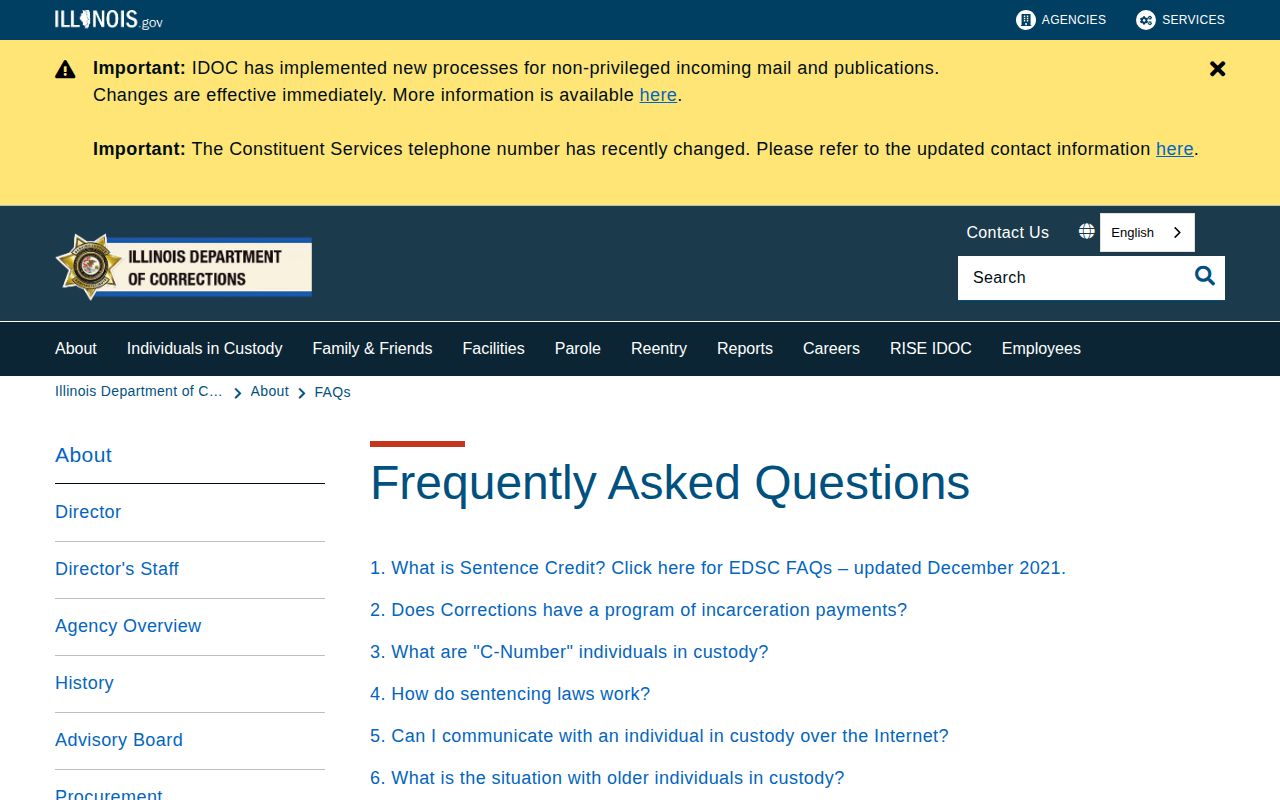
The agency screenshot supports reading the live record instead of estimating from sentence length.
Johnson Court Release Date Records
The Johnson criminal case explains the legal basis for custody and release. Judici lists Johnson County as a participating court and reports electronic criminal and civil files current from April 1987. Search by name or case number, then use the Circuit Clerk for a complete or certified file. The useful documents include the pretrial-release or detention order, judgment, sentence, mittimus, custody-credit entries, amended orders, and probation or conditional-discharge record.
A court date is not a door-out time. The order may authorize release while a host still completes identification, property return, another hold check, or transport. Conversely, a host movement can show transfer to IDOC rather than freedom in the community. Match the court authority to Massac or Saline's date, time, release type, and destination.
For a certified copy, contact the Johnson Circuit Clerk at 618-658-4751. The official courthouse schedule is split between morning and afternoon hours. Ask about current search, copying, and certification fees because no current Johnson-specific fee table was verified.
Johnson IDOC Calculation Records
The public profile is a concise view, not the complete sentence-calculation file. When dates or term structures appear inconsistent, a focused request to the IDOC FOIA Officer can seek releasable calculation, release, or discharge material. Identify the person by full name and IDOC number, specify the relevant sentence or case, and ask for electronic portions. A broad request for the confidential master file is less useful.
IDOC's sentence-calculation directive describes the agency process. The release-procedures directive addresses identification, paperwork, property, clothing, and transport at the end of confinement. Those operational steps can affect the final movement record, but they do not rewrite the statutory sentence calculation.
Admission Date also matters. It is not always the first day credited toward the sentence because presentence or county custody credit can come from the court order. Sentence blocks list custody date, county, offense, term, class, and case information. Compare those details before relying on one projected field.
Johnson Release Holds and Transfers
A detainer is a request or notice from another authority that can affect where a person goes when current custody ends. A host-jail release to IDOC, another county, federal marshals, or ICE is still a release from that host, but it is not necessarily release to the community. The destination field is therefore as important as the timestamp.
For an IDOC prisoner, the public status may change after a prison departure while MSR remains active. Projected Discharge Date may be later than Projected Parole Date because legal control continues. A new violation or custody event can produce a different status after the original release.
No federal or ICE detention facility is mapped in Johnson County. If a federal detainer is involved, use the federal docket, actual contract jail, and the correct BOP, ICE, or USMS channel. Do not infer federal release from a Johnson or IDOC record alone.
Johnson Release Date Evidence
Release-date proof grows stronger as the event moves from projection to completion. Before the date, the best source is the current calculation from IDOC Records or the host jail, read with the sentencing order. On the day of processing, status can lag while staff finish identification, property, paperwork, and destination checks. Afterward, the dated movement or discharge record is stronger than a cached profile.
Use exact identifiers in every inquiry. For IDOC, the IDOC number is the most precise search key. For a local Johnson case, use the case number, arrest date, arresting agency, host, and booking number. This prevents a record from being attached to a person with a similar name.
A release record should answer who left, which facility released the person, when the movement occurred, who authorized it, what release type was used, and where the person went. If destination is missing, ask whether the movement was community release, transfer to IDOC, another jail, federal or immigration custody, or medical placement.
Johnson Parole and Discharge Dates
These distinctions matter when planning pickup, confirming supervision, or requesting a completed release record.
Parole, MSR, and discharge are not interchangeable. For a modern determinate sentence, IDOC generally calculates the confinement end and MSR follows by statute. The PRB sets or enforces conditions but generally does not choose that prison-exit date. For older indeterminate cases and eligible youthful-parole matters, a board hearing can have a different role.
PRB calendars show that a matter is scheduled, not that release was granted. Read current results, past parole records, or approved minutes for the outcome. A grant may still require operational processing and review of other custody obligations. A denial or deferral affects the expected path but must be tied to the correct case.
Projected Discharge Date can extend beyond Projected Parole Date because state legal control continues after prison. The sentence-level discharge flag supplies another clue. A final agency record is needed when the public fields seem inconsistent or when formal proof matters.
Public Record Search
Sponsored Results